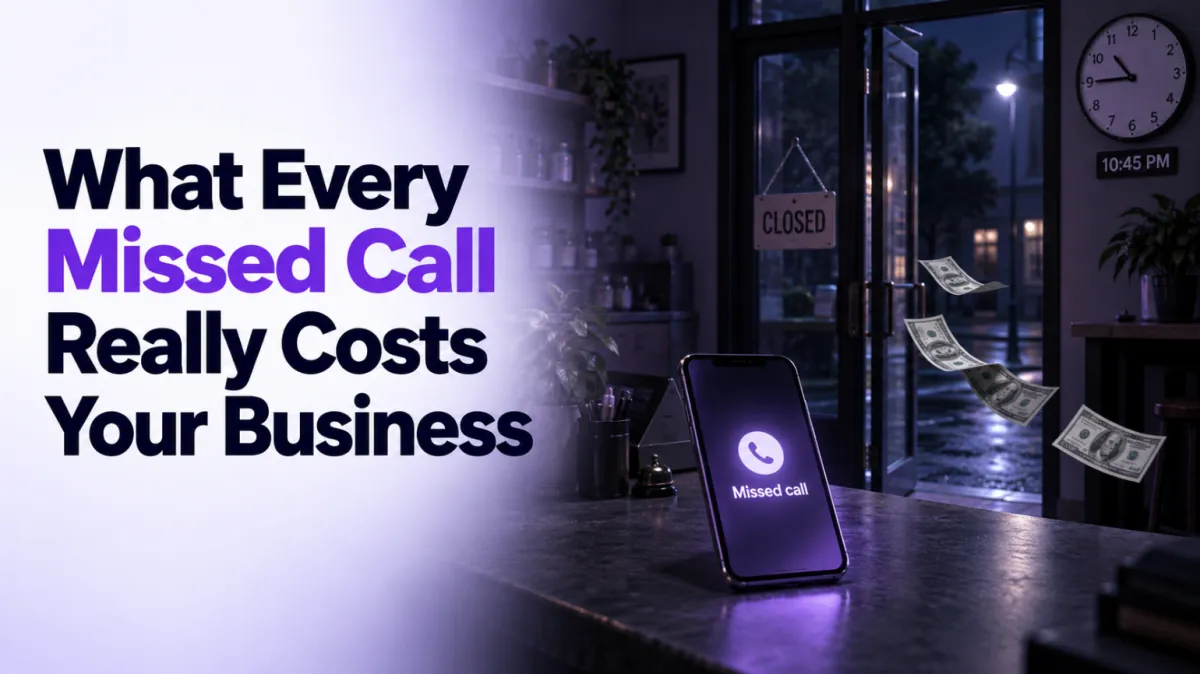
How Much Are Missed Calls Really Costing Your Business?
Nobody puts "missed calls" on their profit and loss statement. There's no line item for the person who rang at 6:40pm, got voicemail, and booked with your competitor by 6:45. Which is exactly why it's the most expensive problem most service businesses don't know they have.
Quick Answer: What is the real cost of missed calls for a small business?
Businesses miss around 62% of after-hours calls and roughly 70% of chat messages, and 85% of callers who reach voicemail never call back. For a service business with an average customer value of $500 that misses just 10 calls a week, that adds up to about $20,000 in lost revenue per month, or $240,000 a year. The fix is instant response: answering every call and message within seconds, at any hour.
Why do most missed calls never call back?
Put yourself in the caller's shoes, because you've been this person. You search for a med spa, a clinic, or a plumber on Google. You call the first one. Voicemail. Do you leave a message and wait patiently by the phone? You do not. You go back to Google and call the next one.
That's the whole mechanism, and the numbers back it up. Around 85% of people whose call goes unanswered never call that business back. Meanwhile, 78% of customers end up booking with the business that responds first. Your competitors aren't beating you on quality or price. They're beating you on speed.
And speed is where most businesses quietly fail. The average business takes around 47 hours to respond to a new lead. Two full days. The customer who was ready to buy on Tuesday evening has been someone else's customer since Tuesday evening.
Where else is the revenue leaking out?
Calls are only the loudest leak. The same silence happens in four other places, usually all at once.
- Website forms. Around 60% of web inquiries never get a follow-up within 24 hours. Someone took the time to type out what they need, and the form went into a folder nobody checks until Friday.
- Website chat. A message sent, a reply hours later, a visitor long gone. Roughly 70% of chat messages go unanswered altogether.
- Social media DMs. Instagram and Facebook messages get seen, mentally filed under "later," and forgotten.
- Reviews. Not a lead source in the same way, but an unanswered negative review quietly costs you the next ten people who read it.
Every one of these is a customer who raised their hand and got silence back.
What does the missed-call math look like for your business?
Here's the calculation worth doing with your own numbers. Take your average new customer value. For a med spa or clinic, $500 is a fair starting point, and plenty of treatments cost more. Now estimate how many calls and messages you miss in a week. Ten is conservative once you count evenings, weekends, lunch breaks, and the times your team was with another customer.
Ten missed opportunities a week at $500 each is $5,000 a week walking out the door. Call it $20,000 a month. Run it across a year and you're looking at $240,000 in revenue that rang your number and gave up.
Even if only half of those callers would ever have booked, the number is still bigger than almost any marketing budget. Which leads to the uncomfortable conclusion most owners eventually reach: it was never a marketing problem. It's a response problem. Spending more on ads to feed a phone nobody answers is filling a bucket with a hole in it.
What changes when every call gets an instant answer?
This is where AI has quietly changed the economics for small businesses. An AI receptionist answers every call in seconds, 24 hours a day. It never puts anyone on hold, never takes a lunch break, and never lets a Saturday evening call ring out.
In practice, it handles the routine work that eats a front desk's day: the same questions about prices, treatments, parking, and opening hours, answered instantly and correctly. It captures the caller's name, number, and email, so the lead is in your system with zero typing. It can text a booking link or your location map while the caller is still on the phone. And when someone genuinely needs a human, like an existing customer with a problem, it forwards the call to the right person based on rules you set.
The same applies beyond the phone. Conversation AI picks up the website chat, SMS, and social media DMs, so those 70% of ignored messages get answers too.
One clinic we work with put an AI receptionist on their line and measured the difference: 11 hours of admin time saved every week, and 100% of calls answered every day. More bookings, not because they spent more on marketing, but because nobody who called got silence.
To be clear, this isn't about replacing your receptionist. Most businesses we see keep their front desk and let the AI take the after-hours calls, the overflow when the line is busy, and the repetitive questions, so the humans can handle the work that actually needs a human. If you want to see what this looks like in practice, our AI communication page has a demo you can try, including a number you can call to talk to an AI receptionist yourself.
Which businesses does this make sense for?
The pattern fits any business where customers call to book or ask questions: med spas, clinics, dental practices, salons, home services, and coaches or consultants who miss calls while they're with clients. It matters most where two things are true: the value of a single new customer is high, and calls arrive outside the hours someone can answer them. If your voicemail greets people at 7pm and your average customer is worth hundreds of dollars, the math above is your math.
Businesses with very low call volume, or those whose customers book entirely online without ever calling or messaging, will feel the difference less. For everyone else, the after-hours calls alone usually pay for the whole system.
Key Takeaways
- Calculate your own missed-call number: average customer value times missed calls per week times four weeks.
- Treat response speed as a revenue lever, since 78% of customers book with the business that answers first.
- Audit all five leak points: phone, web forms, website chat, social DMs, and reviews.
- Answer after-hours calls automatically, because 62% of them are currently going nowhere.
- Fix response before spending more on marketing, so your ads feed a system that actually picks up.
FAQs
How many calls does the average small business miss?
Studies and our own customer data point to around 62% of after-hours calls going unanswered, plus a share of daytime calls missed during busy periods. Most owners underestimate their number because voicemail hides it: you never hear about the callers who hung up and moved on.
Do customers really refuse to leave voicemails?
Overwhelmingly, yes. About 85% of callers who reach voicemail never call back. When someone wants a service now, the next provider is one Google search away, so voicemail works more like a goodbye message than a queue.
What does an AI receptionist actually do on a call?
It answers instantly, asks whether the caller is new or existing, answers common questions about services and prices, captures contact details, sends booking links or directions by text, and forwards the call to a human when your rules say it should. You get a transcript of every conversation by email.
Will an AI receptionist replace my front desk staff?
It doesn't have to, and usually shouldn't. Most businesses use AI for after-hours calls, overflow, and repetitive questions, which frees their team for in-person customers and complex conversations. One clinic we work with saved 11 admin hours a week without reducing staff.
How fast should a business respond to a new lead?
Within minutes, ideally seconds. The average business takes about 47 hours, and 78% of customers book with whoever responds first. Instant response is one of the few advantages a small business can hold over larger competitors.
Want more like this?
If you'd like to find out what your phone is costing you, the fastest way is to stop missing calls for two weeks and watch what changes. You can start a free 14 day trial of PulseGrowth, which includes the AI receptionist, conversation AI, CRM, and automation in one platform. Start free, and we'll help you get it set up, so your calls are answered before the trial is over. More guides like this one live on our blog.
The PulseGrowth Team


