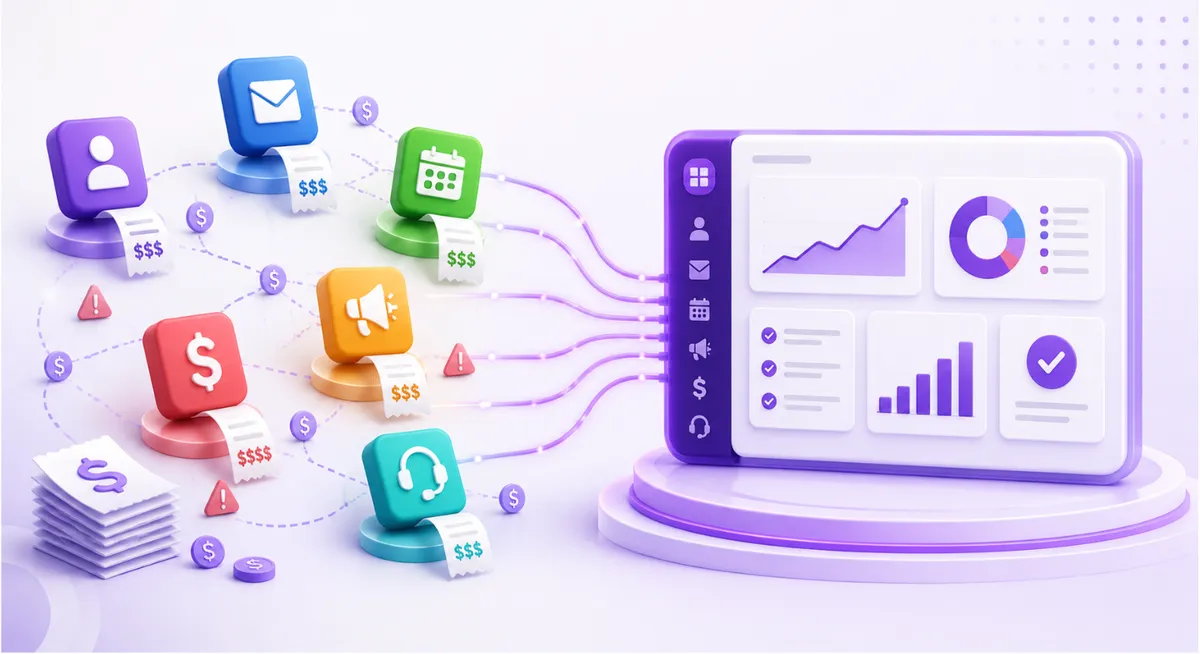
5 Hidden Costs of Multiple Software Subscriptions
Most business owners know exactly how much they spend on rent, salaries, and utilities. But there is one expense that often slips under the radar: software subscriptions.
At first, signing up for another application seems like an easy decision. Need a CRM? Subscribe. Want to send email campaigns? Pay for another platform. Need appointment booking, sales funnels, reputation management, or SMS marketing? Before long, your business is paying for half a dozen different software tools that all do different jobs.
The monthly costs add up quickly, but the financial impact is only part of the problem. Using too many platforms creates inefficiencies that slow your team down and make it harder to grow.
At Pulse Growth, we believe businesses should spend less time managing software and more time serving customers. Below, we highlight five hidden costs of maintaining several subscriptions when one platform can do the work.
The Monthly Costs Add Up Faster Than You Think
Many business owners underestimate how much they spend on software each month. Part of the problem is that businesses often keep paying for software they no longer need, simply because those subscriptions have become part of their routine.
This is money that could be put to better use somewhere else. It could go toward more staff, better advertising campaigns, improved customer service, or new products. These alternatives often deliver a much better return than maintaining an ever-growing list of subscriptions.
Too Many Dashboards Create Too Much Work
Cost is only one side of the problem. Every platform has its own dashboard, settings, reports, notifications, and way of doing things. Your team spends valuable time switching between systems instead of focusing on customers.
Finding customer information becomes harder because it lives in multiple places. Sales data sits in one application. Marketing results sits somewhere else. Appointment information is stored in another system entirely.
Instead of having one complete picture of your business, you end up piecing together information from several different platforms. This creates unnecessary work and makes decision-making slower than it needs to be.
Disconnected Tools Limit Automation
It gets worse. In the age of AI, automation has the potential to help businesses scale rapidly. But automation works best when every part of your business communicates with each other. Unfortunately, that becomes difficult when your software comes from several different providers.
You may need expensive integrations just to make basic information flow between systems, which often means paying for another subscription. Even then, those integrations are not always reliable. Data can become delayed, duplicated, or lost altogether.
Consider this: your customer information is spread across different applications, making it harder to generate meaningful insights. This means you cannot easily see the full customer journey or understand which marketing efforts are producing the best results. You have all the data, but you cannot fully leverage it.
Why Should Growth Cost More?
Perhaps the most frustrating part of modern software pricing is the per-user model. Many providers charge businesses every time another employee needs access to the platform.
Think about that for a moment. Your business grows. You hire another salesperson, administrator, or customer service representative. Before they even start working, your monthly software bill increases.
It almost feels like being punished for success. Growth should improve profitability, not create higher software costs every time your team expands. Sadly, this pricing model has become the norm across CRM platforms, marketing software, and many other business applications.
This becomes an even bigger issue as your company expands, which is why software costs often rise as your business grows.
Even Your Passwords Become a Problem
There is another hidden frustration that rarely gets discussed. The more software you use, the more usernames and passwords your team has to remember.
You have probably experienced this before. You open a platform only to realise you cannot remember the password. You reset it, wait for the verification email, create a new password, and finally log in. A few hours later, the same thing happens with another application.
It sounds like a small issue, but these interruptions happen repeatedly across the working week. Individually, they waste only a few minutes. Across an entire team over the course of a year, they add up to many hours of lost productivity.
Final Note
The pain points highlighted above are why Pulse Growth takes a different approach. Instead of asking businesses to juggle multiple subscriptions and dashboards, we combine everything into one platform.
You can manage your CRM, sales pipeline, email marketing, SMS campaigns, appointment booking, sales funnels, websites, reputation management, online courses, and more without switching between different systems.
Better still, there are no user limits. Whether your business has five employees or fifty, everyone can use the platform without increasing your monthly subscription. The result is lower costs, simpler workflows, better automation, and smarter business insights because all your information lives in one place.
Do you want to see how much you could be saving? Check out our comparison table.