How to Get Your Business Recommended by ChatGPT (and Other AI Tools)
A new lead recently booked a call with a business we know well. When asked how she found it, her answer wasn't Google, a referral, or an ad. ChatGPT recommended the business and showed her the website, and she booked from there.
That's not a fluke anymore. People are asking AI tools who to hire, and the tools are answering with names. The real question is how to get recommended by ChatGPT instead of watching it send customers to someone else.
Quick Answer: How do you get your business recommended by ChatGPT?
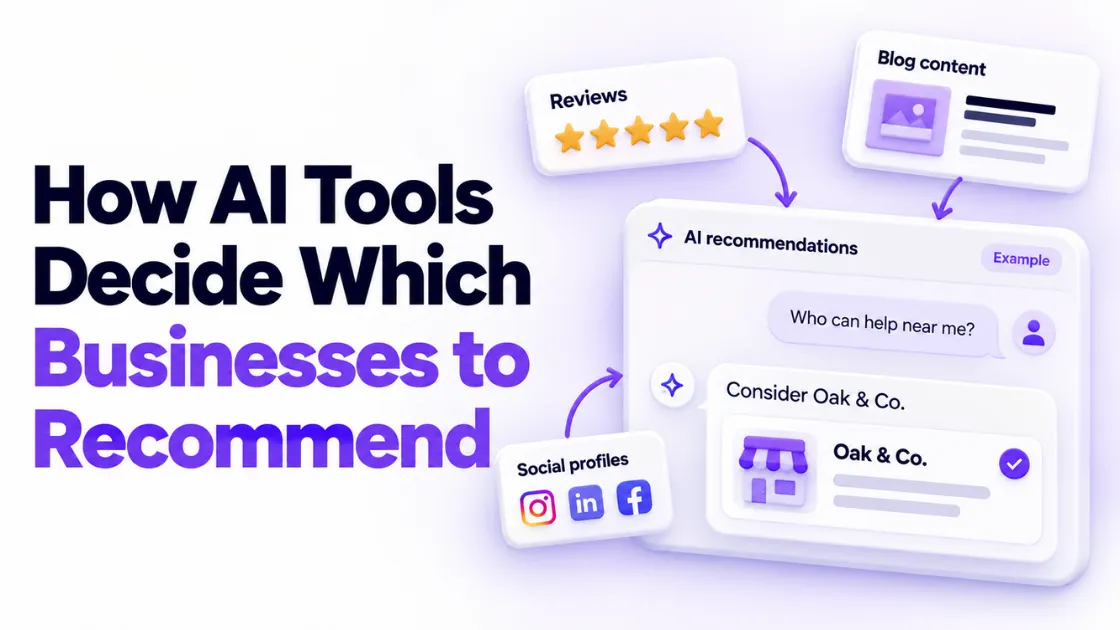
AI tools recommend businesses they can find and verify. That means a website that clearly says what you do and where, a steady stream of customer reviews, published content like blog posts, and mentions of your business on other sites (links and citations). There's no form to fill in and no fee to pay. You earn the recommendation by leaving a consistent, trustworthy trail of information online.
Why would ChatGPT recommend one business over another?
ChatGPT, Perplexity, Google's AI Overviews, and similar tools don't know your business personally. They work from what's been written about you: your site, your reviews, directories, articles, and the places your name shows up with the same details each time.
When someone asks "who's a good med spa near me" or "best bookkeeper for contractors," the AI pulls together the businesses it can describe with confidence. A business with 200 recent reviews, a clear website, and mentions across the web is easy to describe. A business with a Facebook page and silence everywhere else is invisible, however good the actual work is.
That's the uncomfortable part. AI doesn't measure how good you are. It measures how well documented you are.
What signals do AI tools actually look for?
Four things keep coming up, and none of them are exotic:
- Customer reviews. Fresh, steady reviews on Google and other platforms are the strongest trust signal you can build. Not a burst of twenty from your launch month three years ago. A steady drip, every week.
- Published content. Blog posts and helpful pages teach AI tools what you know and who you serve. Every real question you answer in writing is another chance to be the source an AI quotes.
- Links and citations. Mentions of your business on directories, local sites, and partner pages confirm you exist. Consistent name, address, and phone details matter more than volume.
- A consistent presence. An active website and social profiles that match each other tell AI tools the business is alive and the details are current.
Does traditional SEO still matter now that AI answers questions?
Yes, and arguably more than before. The foundations haven't changed: ask for reviews, stay visible on social media, write blogs, build links and citations. That's exactly the data AI tools learn from. Traditional SEO is how AI tools know about you in the first place.
What's changed is the payoff. The same work that used to earn you a spot on page one of Google now also earns you a sentence in an AI answer. Skip it, and you're absent from both.
Honest caveat: this is more work than it used to be, for businesses and for the people helping them. Nobody gets to set up a website once and coast. The good news is that far more of it can be automated than a decade ago.
How do you build these signals without hiring a marketing team?
This is where most owners stall. Asking every customer for a review, every time, is a habit that dies by Thursday when it depends on memory.
So don't let it depend on memory. With PulseGrowth, an all-in-one CRM and automation platform for service businesses, review requests go out automatically after every job or appointment, your blog and social content runs from one place, and your contact details stay consistent across your pages. The routine that makes AI tools trust you becomes something that happens in the background, not another job on your plate. You can see how the AI features handle the day-to-day pieces.
This matters most for businesses people research before buying: clinics and med spas, coaches and consultants, home services, legal and financial practices, and local businesses competing with bigger names. If customers compare before they choose, AI is now part of that comparison.
Key Takeaways
- Treat AI tools like your most skeptical customer: they only recommend what they can verify.
- Collect reviews continuously, because a steady drip beats an old pile.
- Publish content that answers the questions your customers actually ask.
- Keep your name, address, and contact details identical everywhere they appear.
- Automate the routine so reviews and follow-up happen without anyone remembering.
FAQs
Can I pay ChatGPT to recommend my business?
No. There's no listing fee or ad placement inside AI answers today. Recommendations come from publicly available information, which means the way in is building a stronger public footprint.
How long does it take to show up in AI recommendations?
There's no fixed timeline, and nobody can promise you a slot. Businesses with established reviews, content, and citations tend to surface sooner. Expect months of consistent activity, not days.
Do Google reviews really affect ChatGPT recommendations?
Reviews are among the strongest public signals about your business. AI tools draw on what the web says about you, and review volume, recency, and rating are a big part of that picture.
Is traditional SEO dead now that people ask AI instead?
No. AI tools learn from the same websites, reviews, and citations that SEO has always built. The foundations are unchanged, and they now feed two result types instead of one.
What's the first thing to fix if I'm starting from zero?
Reviews. They're the fastest trust signal to build and they help with Google and AI at the same time. Set up an automatic review request after every completed job or appointment.
Want more like this?
Try PulseGrowth free for 14 days and put your review requests, follow-up, and content on autopilot. Start free, and we'll help you get it set up. Start your free 14 day trial here.
The PulseGrowth Team


