How to Train AI to Write in Your Brand Voice
Ask AI to write a post for your business and you'll get something perfectly fine. Perfectly fine, and identical to what it wrote for the dental clinic down the road and the coach three time zones away. The problem isn't the AI. The problem is that nobody told it who it's writing for.
Quick Answer: How do you train AI to write in your brand voice?
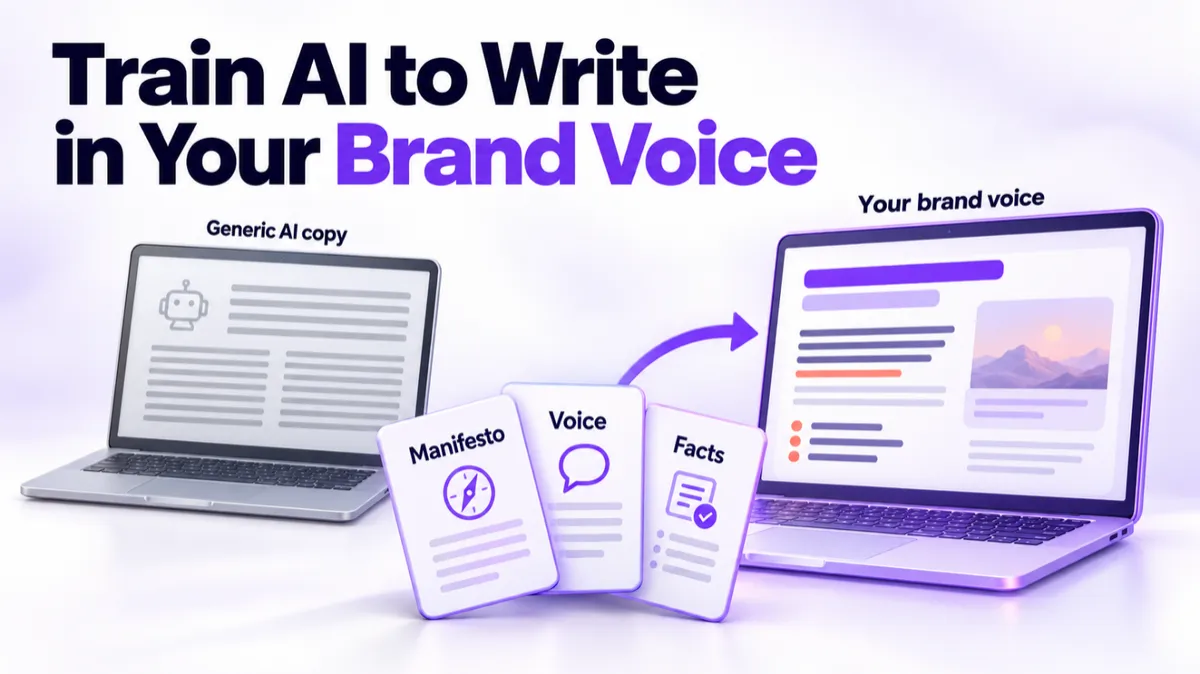
You train AI to write in your brand voice by giving it three short documents before it writes anything: a marketing manifesto (who you serve, what you believe, what you promise), a brand voice guide (how you sound and how you never sound), and a fact dossier (the true details of your business). You build these once, then attach them to every writing task. The AI stops guessing and starts sounding like you.
Why does all AI content sound the same?
Because most people give AI the same brief: a topic and a word count. Nothing about their values, their customers, or the way they actually talk. So the AI falls back on the average of everything it has ever read, and the average of the internet is exactly what generic AI content sounds like.
Here's the thing we keep seeing with the service businesses we work with: the owners who get great content out of AI aren't better at writing prompts. They've simply done a one time piece of homework. They've written down who they are, and they hand that to the AI every single time.
Think of it like a new hire. If a new marketing assistant started Monday and you gave them zero information about your business, you wouldn't be surprised when their first draft sounded like it came from a stranger. AI is that new hire, every single session, unless you give it a memory.
What documents does AI actually need?
Three of them. Each one does a different job, and each one is shorter than you'd think.
1. A marketing manifesto
This is the foundation. It answers the questions that shape everything else: who do you actually serve, and what problem do you solve for them? What do you believe about your industry that most people get wrong? What do you promise every customer? What do you refuse to do, even when it would make you more money?
Vague answers here produce vague content everywhere else. "We serve small businesses" teaches the AI nothing. "We serve busy clinic owners who lose patients because nobody answers the phone after 6pm" gives it a person to write to.
2. A brand voice guide
This one covers how you sound. Start with three words for how you always sound and three words for how you never sound. Warm, direct, practical. Never corporate, pushy, or robotic. Then explain your offer the way you'd explain it to a friend over coffee, with no jargon, and write that down word for word. That paragraph alone will fix more AI drafts than any prompt trick.
Add your hard rules too. Words you'd never use. Phrases that make you cringe. How you feel about emojis and exclamation marks. AI follows rules like these surprisingly well, but only if they exist somewhere it can read them.
3. A fact dossier
This is the boring document that saves you the most embarrassment. It's a plain list of what's true: your business name and how it's spelled, what year you started, where you serve customers, your services and prices, your contact details, and the results you've actually achieved. Nothing aspirational, just facts.
Skip it and the AI will confidently invent a founding year, a price, or a result you never got. AI doesn't lie on purpose. It fills gaps. The dossier removes the gaps.
If you're the face of the business, add a short personal version as well: your name as it should be written, your background, and the one sentence story of how you got here. That's what stops AI writing a bio that sounds like a stranger wrote it from your LinkedIn headline.
By the way, this is the same approach we use inside PulseGrowth, an all-in-one CRM and automation platform for service businesses. When we set up AI chat and voice assistants for our customers, we train them on a knowledge base built from exactly this kind of material, so the AI answering your leads sounds like your business and sticks to your real facts. You can see how that works on our AI communication page.
How do you build these documents without losing a week?
You talk them out. Honestly, the fastest way we've found is to skip the blank page entirely.
- Open the questions above and answer them out loud. Use your phone's voice notes, a transcription app, or the voice mode in ChatGPT or Claude. Ramble. Repeat yourself. It doesn't matter.
- Paste the messy transcript into your AI tool and ask it to turn your answers into a clean, structured document in your own words. Your words, tidied up. Not the AI's words.
- Read it back and fix anything that doesn't sound like you. If a sentence makes you wince, cut it. You're the editor here, not the writer, which is a much faster job.
Budget an evening for all three documents. Not a week. And they don't need to be perfect, because you'll naturally sharpen them the first few times you use them and notice what the AI still gets wrong.
How do you use the documents once they exist?
Attach them at the start of every writing task. Most AI tools now let you save standing instructions, so you set the documents up once and every future draft starts from them automatically. In ChatGPT that's a Project or custom instructions. In Claude that's a Project or a skill. Even without those features, you can paste the documents in at the top of a chat and get the same result.
Then watch what changes. The first draft will need less editing. The facts will be right. The tone will be close enough that you're tweaking sentences instead of rewriting pages. That's the entire point: you stop being the person who writes everything and become the person who approves it.
One warning from experience: keep the documents updated. If your prices change or you drop a service, update the dossier the same week. An AI trained on last year's facts is worse than an AI trained on none, because it sounds confident while being wrong.
Which businesses does this actually work for?
Any business where one person's voice or one clear brand carries the marketing. Coaches and consultants get the most dramatic results, because their voice is the product. Med spas, clinics, salons, and home service businesses benefit in a different way: their content stops sounding like it came from a template library, and their AI assistants answer customers with the right facts instead of polite guesses.
If you're a larger team, the documents matter even more. They're how five different people (and their five different AI tools) end up sounding like one business.
Key Takeaways
- Write a marketing manifesto that captures who you serve, what you believe, and what you promise.
- Create a brand voice guide with three words for how you always sound and three for how you never sound.
- Build a fact dossier so AI stops inventing prices, dates, and results.
- Talk your answers out loud and let AI structure the transcript, instead of starting from a blank page.
- Attach the documents to every writing task and update them whenever your business changes.
FAQs
How long does it take to train AI on my brand voice?
One focused evening covers all three documents. Answer the questions out loud, have AI structure your transcript, then edit until it sounds like you. Most owners refine the documents over the first two weeks of use.
Do I need special software to do this?
No. Any major AI tool works, including ChatGPT and Claude. The training lives in the documents, not the software, so you can switch tools later and take your voice with you.
Will AI content trained this way still need editing?
Yes, but far less. Expect to tweak sentences rather than rewrite pages. You should always read anything before it goes out under your name.
What's the difference between a brand voice guide and a marketing manifesto?
The manifesto covers what you stand for: your audience, beliefs, and promises. The voice guide covers how you sound: tone, words you use, and words you avoid. AI needs both to write like you.
Can AI answer my customers in my brand voice too?
Yes. The same documents can train an AI chat or voice assistant, so the AI answering your calls and messages uses your tone and your real facts. That's how we set up AI assistants for businesses on PulseGrowth.
Want more like this?
If you'd like AI that already knows your business answering your leads, writing your follow-ups, and booking your appointments, you can start a free 14 day trial of PulseGrowth. It includes the CRM, automation, and AI tools in one place, and we help you get it set up, so you start free and go live with your setup done alongside our team. You can also browse more guides like this on our blog.
The PulseGrowth Team


